What makes schools beacons of excellence? Is it their outstanding exam results, progressive teaching practices or their inclusive culture? While academic excellence remains the key measure of school success, equal attention should be given to the well-being of those who make learning happen. This paper seeks to explore the collective responsibility of policy makers, teacher educators, and school leaders in maintaining educational excellence through safeguarding teacher’s well-being.
Well-Being as a Professional Construct
Teacher well-being extends beyond simply the lack of stress. A definition of teacher well-being is encapsulated in the Teaching Compass, developed by the global OECD initiative, which defines it as a holistic approach and as a condition of having a steady sense of physical, cognitive and socio-emotional well-being (OECD, 2025a; see Figure 1). The importance of this combination could be better explained through self-determination theory, which states that motivation and mental health are enhanced when individuals meet their needs of competence, relatedness, and autonomy (Ryan & Deci, 2000). When maintained, teachers themselves are likely to have increased ability to use new approaches and respond to learners’ needs in a way that demonstrates their psychological, pedagogical and professional competence.
Figure 1
Three Interconnected Dimensions of Teacher Well-Being
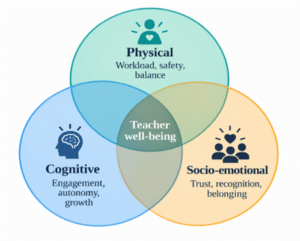
Note. Adapted from the dimensions defined in OECD (2025a).
Teacher Well-Being and Student Learning
Teaching is widely regarded as a complex profession. According to Jennings and Greenberg (2009), teachers’ social and emotional competence is expected to impact the classroom climate, teacher-student relations, and student achievement. Likewise, Braun et al. (2020) linked teachers’ emotional regulation and burnout to student well-being as teachers do more than delivering curriculum; they establish the emotional and intellectual environments in which students learn. Yet, with scores, the evidence does not necessarily show causality as well-being can be considered an enabler of effective teaching, but not necessarily a guarantee of higher scores among learners (Dreer, 2023).
Systems Shape Well-Being
However, individual resilience alone may be insufficient to mitigate the impact of structural challenges within education systems. This is supported by findings from the Teaching and Learning International Survey (TALIS 2024), conducted by (OECD), which drew on the perspectives of approximately 280,000 teachers and school leaders across 55 education systems. The findings identify workload as a major source of occupational stress, with administrative demands, marking, lesson preparation, classroom management, and responsibility for student achievement among the key contributing factors. Nearly 50% of teachers reported experiencing considerable work-related stress, while 28% indicated that their work negatively affected their mental health. Conversely, teachers who engaged in collaborative practices, such as teamwork and joint planning, tended to report higher levels of well-being and job satisfaction (OECD, 2025b). Collectively, these findings underscore the need for a holistic institutional approach that addresses systemic sources of stress and fosters professional collaboration, rather than relying solely on teachers’ individual capacity to cope with workplace pressures.
The TALIS findings also draw attention to “change fatigue”, suggesting that the introduction of multiple school initiatives, which might be very appealing for parents or school leadership teams, can add to teachers’ professional workload. Policy improvement should therefore involve not only introducing new reforms but also managing their pace and actively engaging teachers in decisions that affect their well-being.
Coaching, Mentorship and Reflection in Teacher Education
Teacher-Educators also have a responsibility towards preparing resilient prospective teachers to embrace job challenges. Pre-service teacher education programs are expected to provide new teachers with pedagogical judgment, relational competence, the habit of reflection, and pragmatic solutions to professional challenges that new teachers encounter during their first years of practice. Studies show that novice teachers who have a mentor are likely to be more satisfied and feel better (OECD, 2025b). Darling-Hammond et al. (2017), after synthesizing the results of 35 high-quality research papers, found evidence of elements that improve the quality of professional development, such as content focus, active learning, collaboration, coaching and reflection, and ongoing participation. While the review of professional development studied did not include well-being, these factors were related to competence and connectedness, both of which self-determination theory indicates are important.
Leadership and Professional Capital
Leaders have the capacity to translate policy into human experience. Professional capital, as conceived by Hargreaves and Fullan (2015), includes human capital (skills and expertise), social capital (building collaborative relationships), and decisional capital (judgement necessary to work through complex issues). These dimensions should be strengthened by leaders by creating organizational conditions that enable teachers to thrive professionally. The evidence suggests that the leaders could free up shared planning time, avoid unnecessary and redundant paperwork, recognize professionalism and provide formative feedback. Furthermore, fostering a culture of trust and autonomy can strengthen teachers’ sense of accountability and empathy, thereby contributing to the development of the school’s professional capital.
Purpose and Ikigai
The final component, purpose, adds another piece to this puzzle. Ikigai, a concept derived from Japanese philosophy and translated as “reason for being”, incorporates four components: passion, societal contribution, competency, and compensation (García & Miralles, 2017), (Figure 2). Dr. Emma Kell stresses the importance of these components as a framework for what keeps teachers meaningfully engaged, resilient and fulfilled over the course of their professional lives. The final criterion serves as a safeguard, indicating that purpose will be maintained by educators only when pay, workload, and recognition are fair. It is also unlikely that purpose only can compensate for challenging work circumstances.
Figure 2
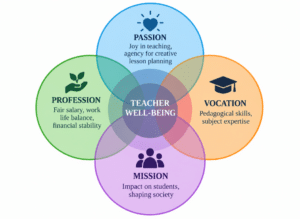
Ikigai as a Lens on Purpose in Teaching
Note: Adapted from García and Miralles (2017)
Conclusion
Achieving educational excellence will be an elusive goal if student performance is the solo success indicator. Research indicates that this often needs to be achieved through alignment among teachers as individuals, teacher education systems and school leadership. The alignment can involve policymakers creating fair conditions for development; teacher educators’ responsiveness; and leaders creating cultures of trust, recognition and social progress. Investing in teachers’ well-being is not a departure from educational excellence, it may be the most credible way to sustain it.